Types of Harm
Child Criminal Exploitation (CCE)
Child Criminal Exploitation (CCE) is a form of abuse that occurs where an individual or group takes advantage of an imbalance in power to coerce, manipulate or deceive a child into taking part in criminal activity (e.g. carrying drugs or weapons, fraud, robberies or involvement in cannabis production).
By moving beyond behavioural labels, this resource hub empowers educators to recognise 'challenging' conduct as a manifestation of grooming and systemic vulnerability. It provides the cultural competency and tactical tools needed to shift from reactive discipline to proactive, aspiration-led safeguarding.
Full podcast



Episode 1
Listen to Chris and Sosa from Unique Talent, talk candidly about their lived experiences of being groomed and exploited as children.
Improve your understanding of what Child Criminal Exploitation (CCE) is, how it occurs, and what school staff can do better to prevent children from being pulled into these harmful exploitative relationships.
Episode 2
Part 2 of this podcast continues the conversation with Chris and Sosa about how schools can improve the prevention of Child Criminal Exploitation and the protection of all children.
In particular:
How bias can influence our decision making
The importance of working collaboratively with parents
The necessity of relational practice where children's emotions, behaviour and physical presentation are seen through a lens of curiosity and trauma informed approaches.
Real Stories
These case studies provide a critical analysis of the mechanisms behind Child Criminal Exploitation and the pathways toward recovery and rehabilitation. By examining the lived experiences of Sosa and Chris, this series offers insights into the grooming process and the systemic vulnerabilities (including childhood trauma, the care system, and domestic instability) that are weaponised by organised crime networks.
Sosa's Story
Chris' Explotation Experiences
Chris' Turning Point
Understanding and Identifying CCE
Child Criminal Exploitation (CCE) is where individuals or groups take advantage of a youth's vulnerabilities for crime. Identifying CCE requires moving beyond behavioural labels to recognising "challenging" behaviour as a result of the grooming process.
This series explores the benefit of schools adopting trauma-informed safeguarding and understanding outbursts as communication rather than simple aggression. It addresses the barrier of adultification, challenging practitioners to recognise how unconscious bias strips children (particularly in minoritised communities) of their victim status.
Watch these videos to understand how CCE is rooted in a search for belonging and learn how to identify early warning signs of grooming.
CPD NOTE: If you are a DSL, use these clips and the accompanying resource (below) to deliver staff updates/CPD about CCE.
Identifying CCE: What Schools Need to Know About Grooming and Risk
Behaviour as Communication: Understanding a Child’s Context
Unconscious Bias: Moving from Labels to Empathy in Schools
Adultification: Safeguarding or Criminalisation?
Prevention
Prevention in the context of Child Criminal Exploitation (CCE) requires more than just awareness; it requires a radical shift in how we empower children, work relationally with both children and families and build strong networks of support in school.
These videos explore how high-level professional exposure and mentorship act as protective shields, providing students with a tangible roadmap to success that makes the risks of County Lines appear less attractive. Understanding the cultural drivers behind exploitation (such as the exploitation of music talent and the pursuit of status symbols), it provides practical insights into creating a Whole School Approach to prevention, ensuring that every child feels valued, heard, and equipped with a legitimate path toward their ambitions.
CPD NOTE: If you are a DSL, use these clips and the accompanying resource (below) to deliver staff updates/CPD about CCE.
Why the Child is Never to Blame
The Role of Culture in CCE
The Role of Music in CCE
Preventing CCE through Work Experience
The Power of a Mentor
Advice To Your Former Self
Intervention
These videos challenge the cycle of meeting fatigue, advocating for tangible advocacy (such as securing qualifications and coordinating specialised local support) over exclusions that often facilitate disengagement. By adopting a Contextual Safeguarding model, schools can map local risks and empower parents as partners, building a robust, multi-agency infrastructure that protects the child from the classroom to the community.
CPD NOTE: If you are a DSL, use these clips and the accompanying resource (below) to deliver staff updates/CPD about CCE.
Better Solutions than Exclusions
Know Your Local Area
Negative Labels and Perceptions
** In this clip you will hear a pejorative term used, but we have kept it in to reflect the attitude of Sosa at the time of his exploitation, and that it is not representative of his approach and views now.
Active listening and Action
The Role of Parents
The Power of Multi-Agency
Further Support on CCE
Questions to Accompany CCE Clips
Use the video clips above, along with these questions to deliver a staff update on CCE

Free training
Explore our broad range of free Safeguarding training, including a session on CCE co-delivered with Unique Talent.

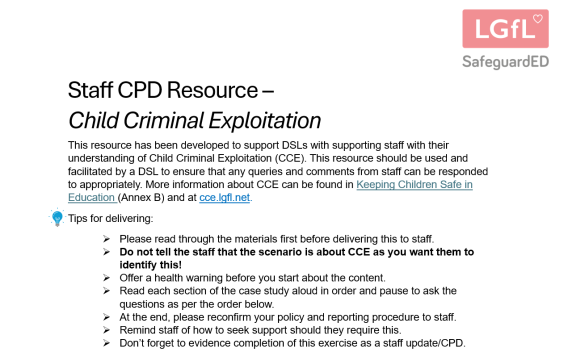
Staff CCE CPD resource
Use this resource in a staff meeting or inset day to enhance their understanding of CCE using a real life example.
Othe CCE Resources
Access our free curation of CCE focused resources to support you in the curriculum, staff awareness and policy development